
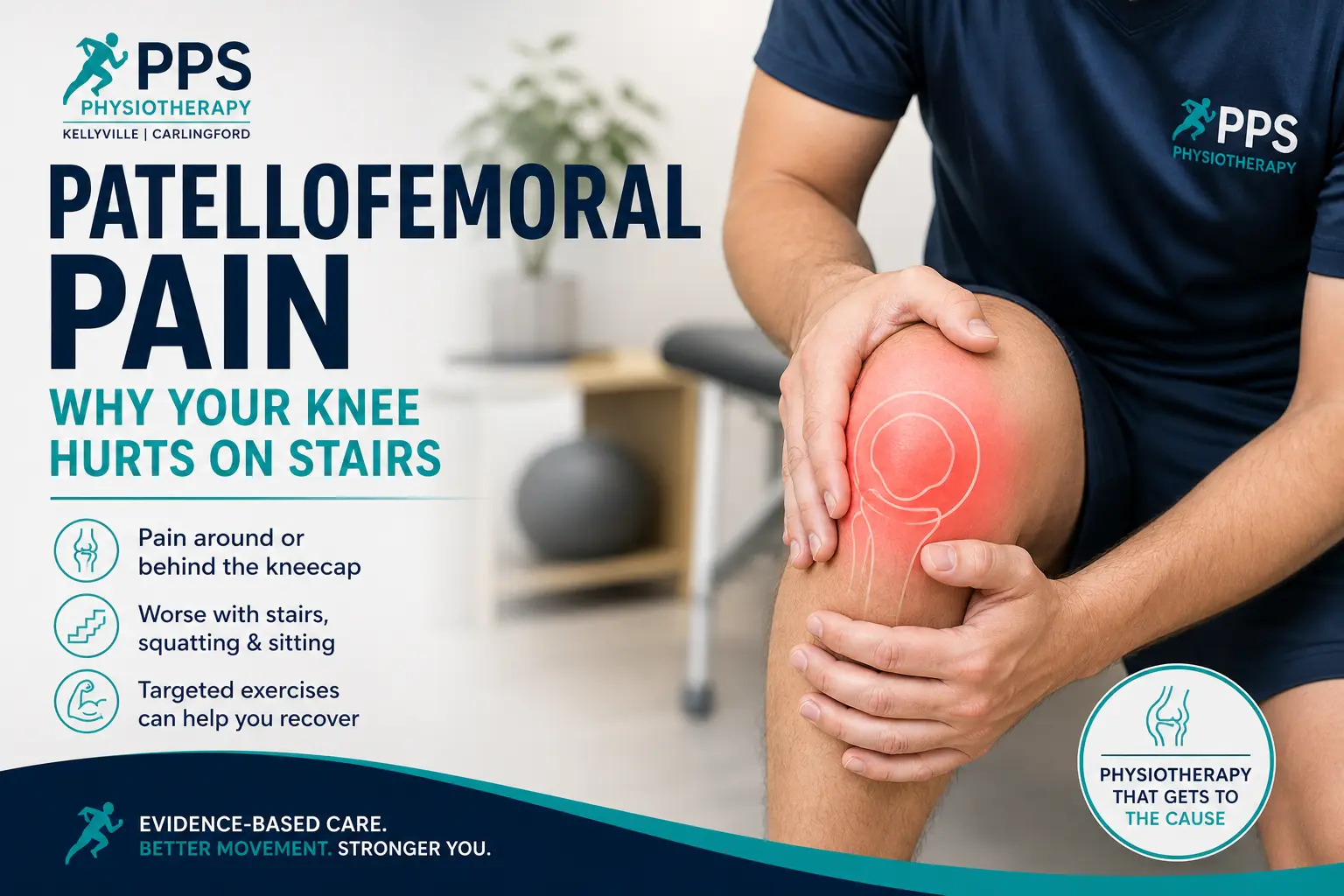
Patellofemoral Pain: Why Your Knee Hurts on Stairs
Last updated: May 2026
Patellofemoral pain is one of the most common reasons people experience knee pain on stairs. It usually feels like an ache around the front of the knee or behind the kneecap, especially when going up or down stairs, squatting or sitting for long periods.
In most cases, the issue is related to how the knee is handling load rather than permanent structural damage. Therefore, a progressive physiotherapy plan can often help reduce symptoms and rebuild confidence with stairs, sport and daily movement.
Looking for a full guide on knee pain when using stairs, including causes, exercises and treatment options?
Read our complete guide to knee pain on stairs in Carlingford here.
What is Patellofemoral Pain?
Patellofemoral pain refers to irritation around the kneecap joint. The kneecap, or patella, normally glides in a groove at the end of the thigh bone. However, when load, strength or movement control is not well balanced, the area can become irritated.
This pain is usually mechanical and load-related. As a result, symptoms often increase with stairs, squats, sit-to-stand movements, running or prolonged sitting.
Importantly, patellofemoral pain is not the same as arthritis, ligament damage or a meniscus injury. Although those conditions can also cause knee pain, this condition is more closely linked to how your muscles, joints and movement patterns work together.
- Typical age group: Teens, young adults and runners, although it can affect anyone.
- Main symptom: Dull ache or sharp pain at the front of the knee.
- Common nickname: Runner’s knee.
Why Does My Knee Hurt on Stairs?
Stairs increase the load through the kneecap joint. For this reason, patellofemoral pain often feels worse when climbing stairs, going downstairs or standing from a low chair.
Think of it like a car tyre that is slightly out of alignment. Over time, repeated uneven loading can irritate the area and make everyday movements feel uncomfortable.
Main Causes of Patellofemoral Pain
Patellofemoral pain usually develops from a combination of factors. Therefore, treatment works best when it addresses strength, movement control and load together.
- Muscle weakness: Weak glutes, hip muscles or quadriceps may reduce knee control.
- Muscle tightness: Tight quads, calves, hamstrings or ITB can increase joint stress.
- Foot mechanics: Flat feet or overpronation may change knee alignment.
- Training errors: Sudden increases in running, squatting or stair use can overload the knee.
- Postural habits: Long periods of sitting with the knees bent can increase symptoms.
The good news is that patellofemoral pain is rarely due to permanent damage. With the right rehab plan, most people improve well.
For a more detailed explanation of knee pain when using stairs and how to manage it, see our full guide here:
Knee Pain on Stairs Treatment in Carlingford.
Symptoms of Patellofemoral Pain
Symptoms often build gradually rather than appearing after one clear injury. Because of this, early assessment can help prevent the problem from becoming persistent.
- Aching or sharp pain at the front of the knee.
- Pain climbing or descending stairs.
- Discomfort when squatting, kneeling or lunging.
- Pain after sitting with bent knees.
- Occasional cracking or grinding sounds.
How Physiotherapy Helps Patellofemoral Pain
Physiotherapy is commonly used as first-line management for patellofemoral pain. At PPS Physiotherapy, our approach focuses on reducing symptoms while rebuilding strength and confidence.
- Comprehensive assessment: Identifying which muscles and movement patterns are contributing to symptoms.
- Hands-on treatment: Manual therapy, massage or taping where appropriate.
- Targeted exercise program: Strengthening glutes, quadriceps and hip control.
- Load management: Adjusting activity levels while keeping you moving.
- Education: Helping you understand what to avoid, modify and gradually rebuild.
In many cases, patients notice improvement within 3–6 weeks of consistent physiotherapy-guided rehab.
Evidence-Based Exercises for Patellofemoral Pain
Exercise selection should match the person’s symptoms, strength and goals. However, the following exercises are commonly used as part of a progressive rehab plan.
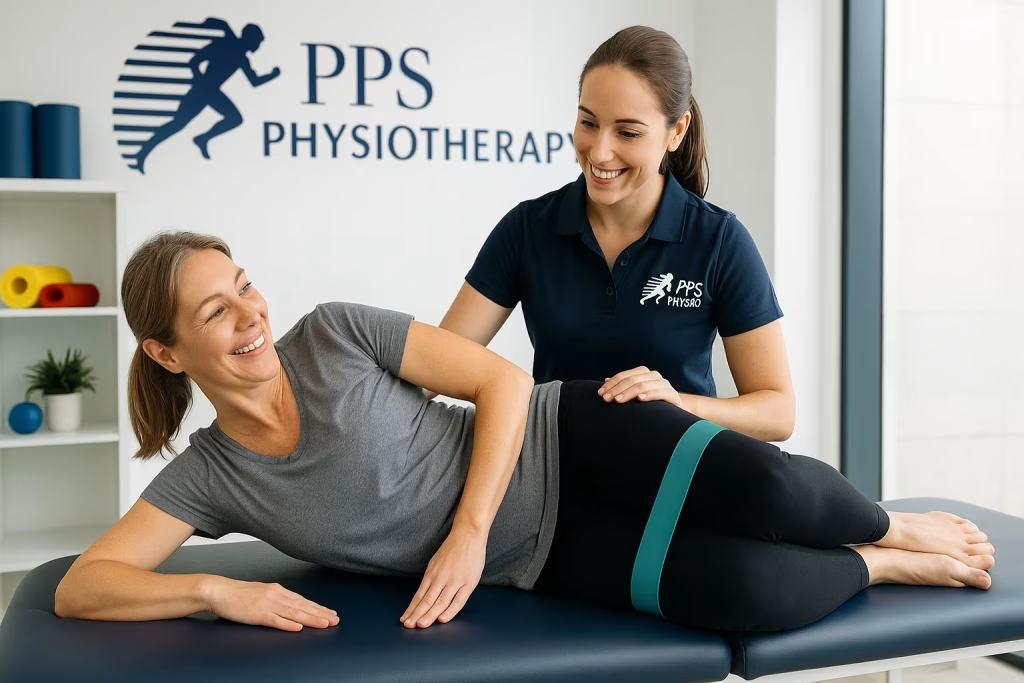
1. Clamshells
Clamshells help improve hip strength and knee control.
- Lie on your side with knees bent.
- Keep your feet together and lift the top knee.
- Perform 2–3 sets of 12 reps per side.
2. Step Downs
Step downs train control for stairs and single-leg movement.
- Stand on a step with one foot off the edge.
- Slowly bend your supporting leg and lower the opposite heel toward the ground.
- Perform 3 sets of 10 reps.
3. Wall Sit with Ball Squeeze
This exercise targets the quadriceps and inner thigh muscles.
- Lean against a wall with knees bent.
- Place a ball or pillow between your knees.
- Squeeze and hold for 30–45 seconds. Repeat 3–5 times.
4. Side-Lying Leg Raises
Side-lying leg raises strengthen the hip stabilisers.
- Lie on your side with the bottom leg bent.
- Lift the top leg straight up while keeping toes forward.
- Perform 3 sets of 12–15 reps.
5. Foam Roller ITB Release
Foam rolling may help reduce outer thigh tension in some people.
- Place the foam roller under the side of your thigh.
- Roll slowly from hip to knee for 1–2 minutes.
Tip: These are starting exercises. Depending on your goals, your physiotherapist may progress you to squats, lunges, step-downs or jumping-based training.
Long-Term Prevention Strategies
Long-term improvement usually depends on strength, consistency and good load management. In addition, small changes to training habits can reduce the chance of flare-ups.
- Build strength gradually: Increase training loads steadily rather than suddenly.
- Maintain flexibility: Stretch quads, calves and hips where needed.
- Check footwear: Supportive shoes may help reduce poor knee alignment.
- Change sitting habits: Avoid long periods with knees bent.
- Warm up properly: Dynamic warm-ups before sport can reduce knee stress.

When to See a Physiotherapist
You should consider seeing a physiotherapist if symptoms last longer than 1–2 weeks or keep returning. Early advice can help you avoid unnecessary rest and start the right rehab plan.
- Pain has lasted longer than 1–2 weeks.
- Symptoms are worsening despite rest or self-care.
- Everyday activities like stairs, squats or sitting are affected.
- You want a safe return to sport, running or gym training.
PPS Physiotherapy has clinics in Kellyville and Carlingford, serving the wider North-West Sydney community.
Frequently Asked Questions
What is the fastest way to relieve patellofemoral pain?
Short-term relief may come from activity modification, taping and reducing painful loads. However, long-term recovery usually requires progressive strengthening.
Can physiotherapy help patellofemoral pain?
Yes. In most cases, people improve well with a structured exercise program and guidance from a physiotherapist.
Is knee cracking a sign of patellofemoral pain?
Cracking or grinding is common and often harmless. However, if it comes with pain, it may be linked to patellofemoral irritation.
Who can help with patellofemoral pain near Kellyville or Carlingford?
PPS Physiotherapy provides evidence-based knee pain treatment in Kellyville and Carlingford, with care tailored to your symptoms and goals.
Book an Appointment
If kneecap pain is stopping you from enjoying sport, stairs or daily life, book your appointment online with PPS Physiotherapy today. Our physios in Kellyville and Carlingford can help you get moving with more confidence.
References
- Crossley KM, et al. Patellofemoral pain consensus statement. Br J Sports Med. 2016;50(14):844–852.
- JOSPT Clinical Practice Guideline: Patellofemoral Pain. J Orthop Sports Phys Ther. 2019;49(9):CPG1–CPG95.
- Neal BS, Lack SD, Bartholomew C, Morrissey D. Best practice guide for patellofemoral pain. British Journal of Sports Medicine. 2024;58(24):1486–1495.
- Powers CM, et al. Patellofemoral joint stress during quadriceps exercises. J Orthop Sports Phys Ther. 2014;44(5):320–327.
