
A recent national campaign by the Australian Physiotherapy Association has reported Physiotherapist’s to be the most recommended health professional by GP’s.
(more…)
The Road to Recovery for Marion
Marion walked into PPS Physiotherapy Kellyville in February 2017 after fracturing her Left patella (knee cap) tripping over at home in late 2016. She underwent surgery to have a wire threaded through the patella to assist in the fracture healing.
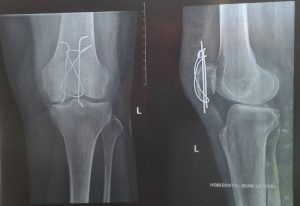
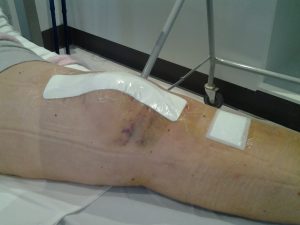
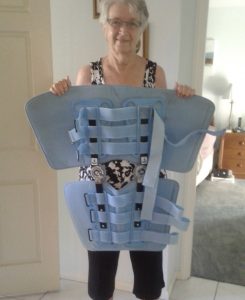
When Marion first attended the clinic she was wearing a knee brace, using a 4 wheeled walker and had high hopes I was about to fit her with a more comfortable knee brace.Unfortunately, the brace Marion was instructed to go into “just for comfort”, was bigger, bulkier and more uncomfortable than her previous brace. I said to Marion I’ll give you a few days and you will be begging to come out of it.
Sure enough 2 days later Marion returned ready to commence physiotherapy and the first thing she said was “you can have the brace back.” Marion started physio with a long rehabilitation road ahead. The first priority was to increase her amount of flexion (bend) and extension (leg straight). On her first session, Marion was able to bend up to 45 degrees and extend out long to -4 degrees from straight. As a bit of a guide against what we would usually see, ideal range is between 125 degrees and 140 degrees of bend. You also need a minimum of 110 degrees to use stairs or complete a full revolution on a bike.
Gradually we began to introduce strengthening exercises, balance tasks, learning to walk again and performing functional exercises.
In March 2017, Marion’s progressed plateaued due to the surgical wire limiting her ability to move and at times it would catch in the knee causing her considerable pain. The surgeon agreed to remove this wire, a few months earlier than desired, to reduce the pain and increase her function. At the same time, a small non-harmful lump was removed from the right knee which we commonly referred to as ‘Lawrence the lump’…so maybe we should make that 3 surgeries now! 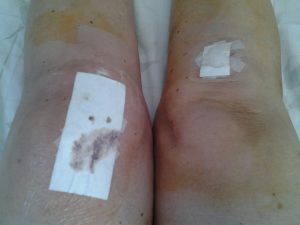
When Marion returned post her second round of surgery her progress again picked up and we were able to make greater achievements.
These included;
– cracking the 90 degrees of flexion (bend) mark and beyond
– completing a full resolution on the bike
– walking without an aid
– being able to return to driving
– becoming more confident using stairs
Today Marion has exceeded expectations and is now able to bend her knee to 137 degrees and extend all the way. She still has some difficulty going downstairs but is working hard on this and is regaining her confidence. Marion is also back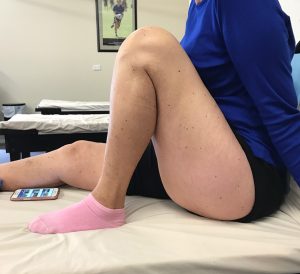 to most activities and is enjoying her ongoing improvements.
Marion was very diligent with sticking to her appointments, rehabilitation plan and home exercises.
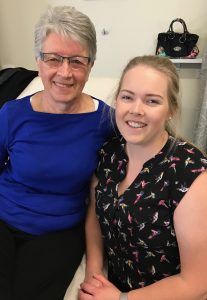
The team at PPS Physiotherapy are very proud to have helped Marion throughout her journey with us and we wish Marion all the best for the future.
Does your single leg hop look like this?
Single Leg Hop
A number of injuries can be avoided by having good motor control, muscle strength, range of motion and balance.
It is not uncommon for us to assess people during functional activities like a squat, single leg balance or single leg hop and notice significant changes. The video below demonstrates a poor single leg hop pattern in a young adult female. This type of landing could result in rupture or the Anterior Cruciate Ligament (ACL), Medial Collateral Ligament (MCL), medial meniscus, patellofemoral pain syndrome, ankle and hip problems.
Anyone who plays a sport that requires jumping and landing, such as AFL, netball, rugby league, rugby union etc and displays this pattern should be assessed to avoid injury.
If you would like to speak to one of our physiotherapists or to book an appointment call (02) 9871 2022 (Carlingford) or (02) 9672 6752 (Kellyville).
5 tips to getting the most out of your physiotherapy treatment
Unfortunately as Physiotherapists we are sometimes expected to be miracle workers or one treatment wonders!
(more…)
FREE Taping Workshop
The team at PPS Physiotherapy would like to invite YOU to attend our FREE strapping workshop!
Learn Sports Strapping From Our Team of Physios!
Learn to strap athletes and kids in sport.
8 Part Myth Busters Series
The team at PPS Physiotherapy have put together an 8 part myth series to bust some of the most commonly held beliefs in sports physiotherapy and the general population.
Solving the Problem of Chronic Ankle Instability
17/5/2017, James Coller. PPS Physiotherapy, Physiotherapist
Have you ever rolled your ankle?
Do you have feelings of chronic instability?
Have you rolled your ankle more than once over the past couple of years?
Most of you would answer yes to one if not all of the above questions! So why are these types of injuries so common and why is it common to repeatedly sprain the same ankle in a relatively short period of time.
(more…)
FREE Exercises to Relieve Low Back Pain
How would it feel to have NO back Pain?
Has your lower back ever been sore?
Are you unsure on what you can do to help relieve your symptoms?
Are you unsure how to strengthen your lower back and prevent back pain?
If you answered yes to the above questions, you may be interested to know that we are about to share with you some simple strategies to help strengthen your lower back and relieve your pain.
See also: Back Pain and Abdominal Strength
Low back pain is one of the leading causes of having to have ‘time off work’ and having to avoid those activities we love to do. Nearly 80% of people will suffer from back pain at some point in their life. It’s important that if your back does flare up, you have a plan of action, ready to go. A plan that you can utilise to help ease your symptoms, a plan that will put you on the road to recovery and living life pain free.
Below are 4 exercises that will help your lower back pain and help to reduce your risk of future injury:
Note: Before jumping straight into these exercises please remember, if you experience any unusual pain or discomfort please stop the activity and seek an assessment from an expert to determine what’s best for you.
- Knee Rocks – This exercise is so simple. It’s a fantastic exercise toe help loosen the lower back and pelvic region. Perform 40 to 50 repetitions of this daily.
- Cat and Camel – Every session should begin with the cat-camel exercise. The cat-camel is a gentle motion exercise (not a stretch) to decrease spinal stiffness and relieve pressure on the nerve roots. This motion can be performed daily. Try 2 sets of 10 a few times a day.
- Dead Bug – Too put simply the deadbug is a great core exercise to help to build spinal stabilization strength. Try 3 sets of 10 once per day.
- Side Bridge (on knees) – The side bridge targets the side abdominal muscles. This is a superior exercise when looking at muscle activation, low spinal load and stabilization. Try 3 sets of 10 on both sides (left and right).
If you would like to learn more about taking care of your back, or having a personalised plan to help prevent back pain, then book in your back appointment today. Feel free to contact us at our Physiotherapy Carlingford (02) 9871-2022 and Physiotherapy Kellyville (02) 9672-6752 clinics.
Meet Our Team
10 Things Physiotherapists Wish You Would or Would Not Do
20/3/17, Kimberley Cochrane (Bach of Physiotherapy, First Class Hons)
Physio’s are kind and caring people and we love to see our patients getting better. At the end of the day, it’s why we chose a career in physiotherapy. However, we occasionally get frustrated too! We have put together a list of our top 10 things we would really love you to know that will help you get better much quicker or prevent injuries occurring in the first place.
(more…)
